
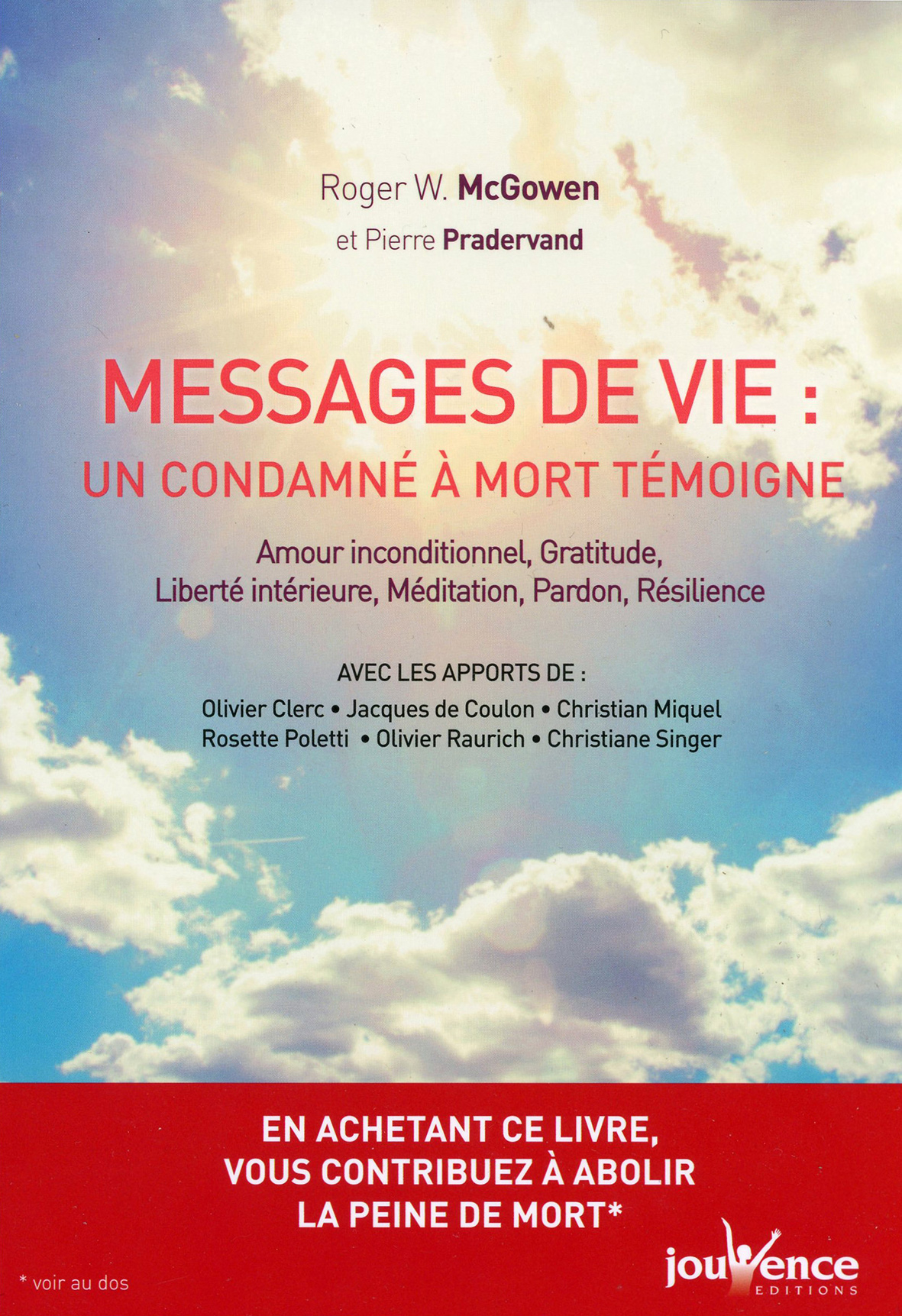
Life Messages - Roger W. McGowen
machine translation
PREFACE
I warn you, reader!
The shock of this text is unstoppable, and the upheaval it causes deep and lasting.
First the discovery of that lagoon where the world comes to an end: the daily life of the buried alive, the men on death row in today's Texan prisons. The isolation, the abuse, the endless cries all through the night — and, as a counter-blade, a humanity expert in inhumanity, an entire penal institution busy tightening the tourniquets, inventing ways of increasing suffering —, a duly legalised State system charged with ensuring, day after day, the degradation and mortification of the prisoners.
And behold, in this hell of demonry there springs up that which can be neither thought, nor imagined, nor dreamed.
A consciousness.
A fragile antenna of truth.
The finest point of human tenderness.
Roger McGowen. That is his name.
His correspondence with Pierre Pradervand gives us an incandescent document. A manuscript of Epictetus for the 21st century.
The sublime and gentle Phrygian slave, born fifty years before Jesus Christ, who in the midst of the worst abuses of servitude invented the most radical of freedoms — the one that neither chains nor irons can hinder —, reappears two thousand years later in a Texan House of the Dead. In the meantime Epictetus has met Christ, another gentle one, another madman — and his amor fati has been joined by an amor dei et homini, a fervent invitation never to confuse the worst of men with his ferocity, to dare to look further, further, further still, as far as the divine seed on which his being is founded.
Yes, I grant it! What Roger tells us goes beyond our customary limits. One is entitled to hesitate, to disbelieve, to look for the flaw... Is Roger not getting his fix of love as others get their fix of hatred? No. For a fix would mean slipping away, trying by every means to escape the awareness of an unbearable fate, and the paranoia it breeds. Here the very opposite takes place: the love that radiates from these letters is born of the clear awareness of what is — an awareness gone through and faced — and not of some intoxication meant to dodge the ferocity of the real! That love passes beyond the killing zone and opens into an unknown space — a space nothing could have led anyone to foresee.
A space without illusion, without for and without against, and of a light so intense that eyes of flesh cannot bear it.
At its touch, rage and indignation melt away, every argument is emptied of its substance; there is no longer anyone to convince of anything. From now on the floodgates of compassion are open and everything overflows.
“I was created to adore,” writes Roger W. McGowen.
Rare are the souls capable of such a reversal. Rare are those who have passed through hatred, despair and indignation to emerge into that secret garden once named by a solar word, today fallen out of use: holiness.
But the green of the pine, says Basho, is neither modern nor ancient.
Holiness is that invisible force which has held the world upright since its creation. It is the deliberate choice a person makes to be whole (heilig, holy), to welcome good as well as evil, justice as well as injustice, cruelty as well as kindness, sickness as well as health — to welcome and to cradle the entirety of what is — without condition, without restriction, to hold against one's breast this scandalous and sublime world as one would cradle a sleeping monster.
In a cell two metres by three, where the light flows in through an arrow slit (!) as wide as a hand, Roger — a Black American imprisoned for murder, sentenced to death, and innocent — teaches us freedom.
Christiane Singer
CHRISTIANE SINGER is the author of some twenty books, all published by Albin Michel. Among them Éloge du mariage, de l'engagement et autres folies, Du bon usage des crises and Où cours-tu ? Ne sais-tu pas que le ciel est en toi ?
AN EXTRAORDINARY MAN AND A VERY
OUT OF THE ORDINARY SAGA.
by Pierre Pradervand,
co-author, Messages of Life from Death Row
Let us search for the deeper meaning of this everyday word rarely used with a clear consciousness of its true meaning and especially the nuances of its significance.
In its original sense, it means something out of the ordinary. However, an ice cream can be
extraordinary, just as a rare concert or remarkable book. It does not put these experiences in the same category. There are extraordinary achievements in the field of technology almost daily, in the field of surgery or scientific research more rarely and they make us pause for a moment.
However, when Mike Horn crosses the North Pole alone with a sledge, on foot, that is quite extraordinary : the word takes on its full meaning of something unique, something that would be very difficult to imitate, something that makes one almost gasp. Its in category that is quite on its own.
And then there are extraordinary achievements in the moral or spiritual field that have a uniqueness and grandeur that lift them to a different level of existence, that shake as in our foundations as human beings, that suddenly reveals a level of possibility that, till now, seemed totally out of reach to most of us: and that has been the saga of Roger W. McGowen.
That is why, to me as to hundreds of others on this little blue planet, he has become what the French call “un maître de vie” a master of life, one who has achieved a level of moral depth and conviction that spontaneously speaks to, and uplifts, any human being with even a slight fibre of sensitivity and listening.
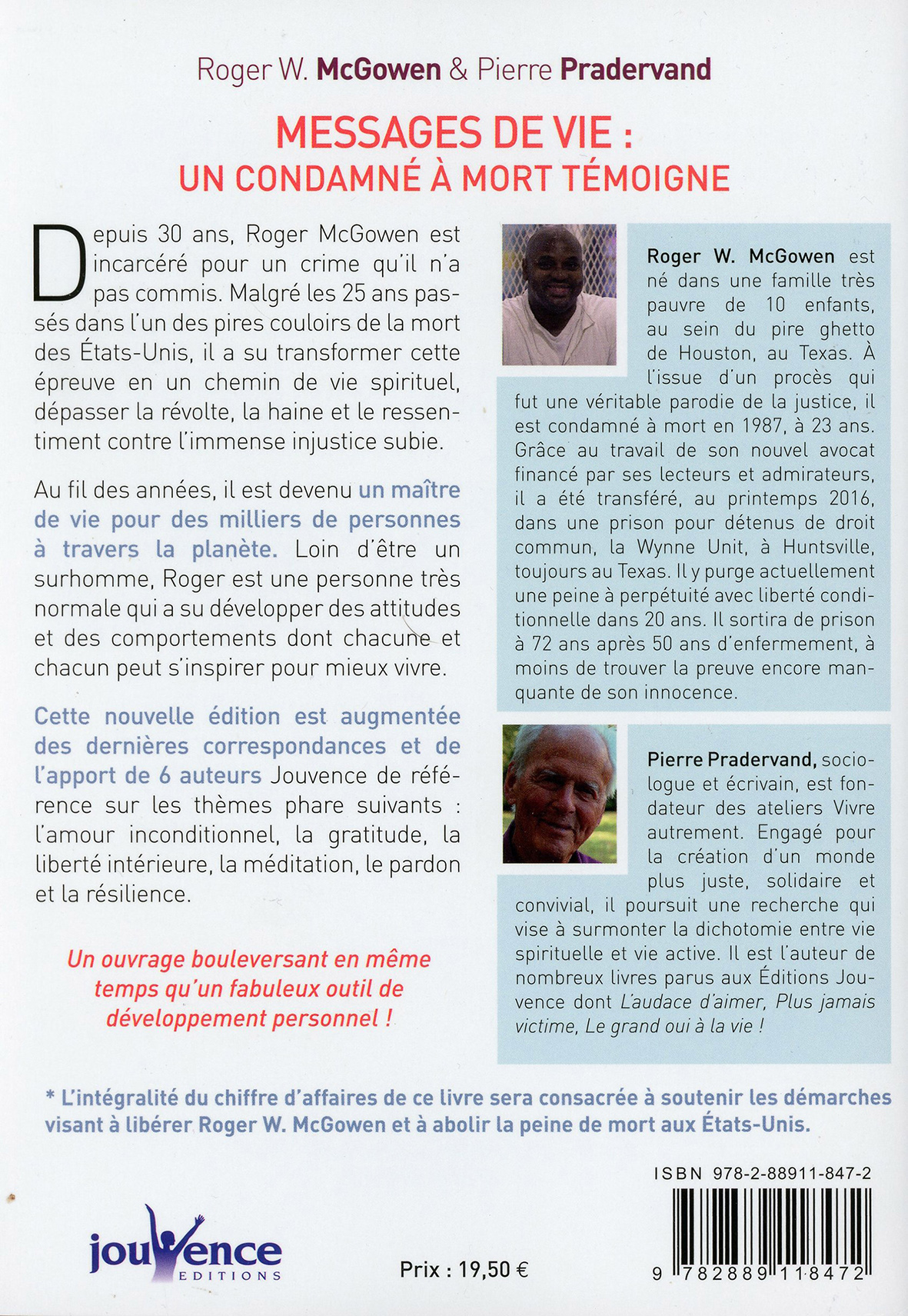
Roger was born in 1963 in Ward 5, one of the worst black ghettos of Houston, in an extremely poor black family of ten children. More than once, he went to school in winter with neither coat nor shoes. Fortunately, he had a grandmother who left a deep spiritual impact on him which can be felt till this day. He is the only one of the ten children to have finished school (and a ghetto school in the seventies in Texas was probably not exactly an advanced place of learning) and, at the time of his mother’s death, the only one to have a job, an apartment and a car. He had an elder brother, Charles, to whom he was totally devoted and whom he quasi deified.
When he was 20, his mother was taken seriously ill and hospitalized where she stayed for days on end in a coma. She happened to come out of it just when Roger was visiting her and entrusted him with her last vows, especially the promise to be his elder brother’s keeper, as Charles had already had serious brushes with the police due to various robberies. She passed on soon after.
Quite a few months later, Charles borrowed his car and, with a mutual cousin, Kerwin,
went to do a holdup which failed and Charles ended by killing the owner of the bar he was robbing. Because a witness had taken down the number plate of the car, Roger was arrested and accused of the holdup and murder. After a grotesque trial which was a total parody of anything even remotely resembling “justice”, he was condemned to death.
His lawyer was a known drunkard who prepared his plea in defence of Roger on the basis of the police report condemning Roger. He never visited his client before the trial, did not make a single phone call to check Roger’s airtight alibi and used to fall asleep in the courtroom snoring so loudly everyone could hear him. He used to brag that he was the US lawyer who had had most clients … condemned to death (17)! Later, the Texas Bar Association prevented from taking on any new death row cases – but the harm was already done.
He entered death row in a state of total revolt, full of a hatred and an anger which was so deep-seated it started seriously undermining his health. Then came a turning point in his life when he realized that he could continue as a victim of an admittedly monstrous system, or accept the huge challenge of making the best of the terrible circumstances of where he was. Which is exactly what happened. With the occasional assistance of a few pen friends who sent him texts and books, he became a self-taught student of spirituality.
I myself as one of his correspondents, (and also a writer,) was so deeply impressed by the quality of Roger’s attitude that I decided to publish a book with a selection of his letters and first hand information on death row, the death penalty and the sometimes very, very strange functioning of Texan justice (which alas has a strong racial bias). Thanks to an exceptional Swiss publisher, the Editions Jouvence, which accepted to publish a book not even remotely related to their usual publications - i.e. new approaches to health and nutrition, new age spirituality, some far-out personal development stuff and the like – the public for the first time was able to encounter this out-of-the-box man, Roger W. McGowen. In addition to Roger’s letters, the book contains also detailed descriptions of death row Texas and the functioning of Texan justice.
Before continuing, I have to explain that death row Texas is one of the closest places to hell I have heard of during a very long career travelling all round the world. Inmates are squeezed in 6-10 foot cells, with only a tiny slit the height of a small coffee mug just below the ceiling, i.e. no daylight worth speaking of. Breakfast is served at 3 a.m. lunch early morning and dinner early-mid afternoon. Inmates have not the slightest physical contact with
anyone except an occasional shove on the shoulder by a guard when walking to the daily shower. Daily exercise on good days is about an hour in a small space with no view whatsoever except cement and metal bars. To communicate, inmates have to yell through the minuscule opening in their doors for the food trays. The starchy quasi junk food served in jail is not exactly what’s needed to enhance ones health.
Of course there is no psychological or religious support and regular practices like the “shakedowns” are just one of the most demeaning prison practices I have ever heard of, especially as they are frequently done with absolutely no reason. Two guards come, handcuff the inmate, take him out of jail and sit him in front of the open door and start ransacking his cell and rare belongings, pouring ketchup on family photos, tearing covers off books, i.e. setting in motion a mini-tsunami often, I repeat, with no reason whatsoever. Roger tells of one such incident when guards put him through a shakedown twice the day of his anniversary (Dec. 23) and then again during the same night, on Dec. 31. Between Jan. 2 and 14, they again ransacked his cell six of seven times.
Twice Roger wrote to me about inmates who had heart attacks days before their execution who were rushed off to the hospital to get them “back into shape” for their execution. Around 350 people were put to death during his 25 years on death row, including some very close friends like Odell Barnes. And yet this is the place of which Roger wrote to a friend of mine, “If I have to die on death row, I will at least have shown that one can be happy there.” Is this man insane? Or does he have an insight few of his fellow inmates would have? In his August 24, 2000 letter he wrote to me, “Concerning the space that I occupy, in itself it no longer bothers me, because it is filled with love”.
This man has reached a spiritual vision he has managed to put into words which touch people in the most intimate way. In one of his letters, he explains that he lets the cockroaches (not most people’s favourite pet) and other crawly creatures run around his cell free, because they too are expressions of life. Just the other day, a woman I met in one of my workshops explained to me that she had been so moved by that passage she had completely stopped squelching insects in her home. A tiny detail - but which says such a lot.
The response to Roger’s book first published in French in 2003 was immediate and amazing. Roger started receiving letters mostly from all over Europe, telling him how his letters were inspiring, sometimes how they had changed people’s lives. Readers started donating funds, sometimes very generously: one German-Swiss lady was so moved she donated $50’000 from an inheritance she had just received. I started receiving requests for lectures for talks in schools and even large international forums.
In 2006, I decided to create an international support group to help me in my efforts to get a new trial for Roger. We hired a lawyer who after six years of efforts and repeated appeals by the district attorney against the judgments in Roger’s favor, finally got a Texan Federal court of Appeals to grant Roger a new trial. But Harris County, where the new trial would have been held, is the county in the US that since the reinstatement of the death penalty has put to death more inmates than any other state! And in recent years, every single death row inmate who was granted a new trial in Harris County, except for one, was re-condemned to death. So our lawyer wasn’t very keen on this route, and ultimately Roger and he chose a plea bargain, i.e. a negotiation between the judge on the case and our lawyer on an alternate sentence. So Roger got prison for life, with the possibility of being released in 2036, i.e. at age 72, after 50 years in jail for a crime we know he never committed.
Something in Roger’s personality, experience, spirituality and sharing touches people in a very special way. The comment I have heard the most frequently is: after having read this book, I will never again be able to complain or feel a victim! He is the living illustration of a statement by Eckhardt Tolle, i.e. that we should face every situation as if we had chosen it. This is one of the most demanding statements I have ever come across in the literature on personal development. It comes out strikingly in a letter he wrote a friend of mine last November where, after he mentions some of the amazing changes he has initiated in the prison culture of the Wynne Unit prison where he is now detained, he states: “We have helped inmates reconnect with their families. We have helped guys buy clothing items, personal hygiene products as well as boots, coffee pots, radios, fans etc.. We provide a monthly Spread of special food items in the Day Room shared freely with all inmates. We have made it possible for guys to go to the commissary who have never been to commissary since being in prison. I have had big tough men who others were afraid of break down and cry and hug me because of the help we were able to provide for them - and that was unheard of before. Gang members who were once rivals sit and eat at the same table together, and that was something unheard of before I came here - with your support behind me.
I could go on and on, but there is no need. We are fighting hate on the front lines. And, many of the guys who we are helping will one day re-enter society and we want them to take the love that they found here with them instead of the hate that came with them. We want them to spread the love that they now know instead of the hate they once knew.
So, I think I am where I am meant to be for the moment. When God thinks this task he has set for me is complete, perhaps there is nothing that will hold me in prison any longer. But until that time comes, I will continue to spread love as far and as wide as I can. And I thank you all for making it possible! You are the unsung heroes! I am, and all of us are putting forth the effort to make life better here. Our efforts are being written on the hearts of everyone who we have shown that love is the greatest power there is, and we are making a difference and that is what counts!
Again, I thank you. There is so much more to say but I want to keep it simple. Love is not complicated, and I do not wish to make it so. I simply say thank you for the love. You are family now. We are related in love and bound by efforts to fight hate. We change minds by changing hearts and we change hearts by changing minds. And we can change the world one heart and one mind at a time.”
In January 2013, the best French-Swiss TV show produced an absolutely outstanding one-hour in presentation of Roger’s story which touched tens of thousands of spectators. One gentleman started donating every single month 2000CHF (the same amount in US dollars) so deeply was he moved ... and he still continues to this day. (And he told me he would continue until his own last breath!)
The latest news on the legal level is that we have hired to young dynamic lawyers who are going to sift through 13 years of legal documents and attempt to find the missing proof or track that would enable us to finally get Roger out of jail. But whether in or out of jail, he himself set his track once and for all: “Love is just one thought away. Remember to use it often. It can never be depleted”.
Come to think of it, what if we adopted that motto for ourselves?
It could make the world a considerably more decent place to live in.